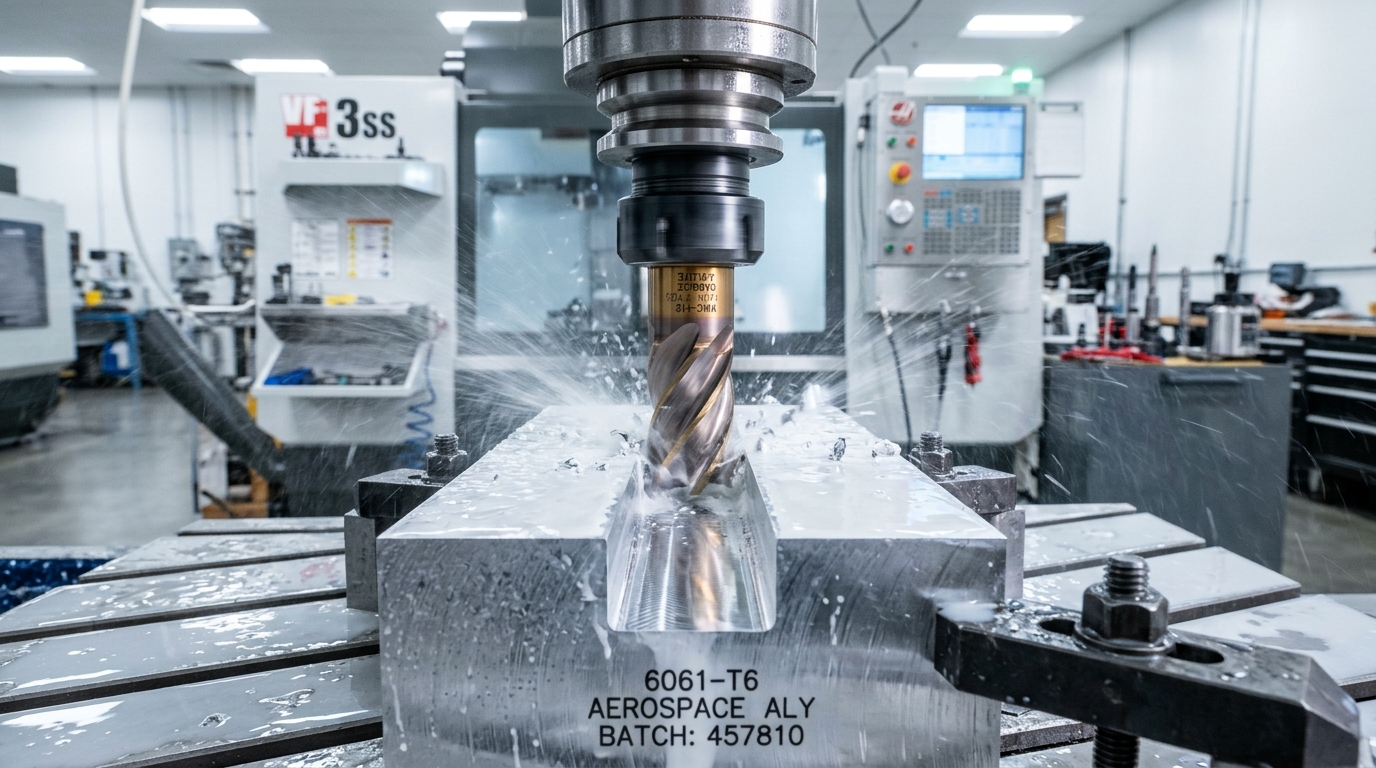
In precision manufacturing, Computer Numerical Control (CNC) machining represents the baseline of repeatable accuracy. Whether cutting a delicate brass die for silicone apparel logos or milling an industrial casting mold core, CNC milling translates digital vector toolpaths into micron-accurate physical metal parts.
The Core Mechanics of 3-Axis Vertical Milling
A standard 3-axis Vertical Machining Center (VMC) coordinates motion across three Cartesian planes: X (left-to-right table traversal), Y (front-to-back saddle motion), and Z (vertical spindle feed). The spindle holds rotating cutting tools—such as end mills, face mills, ball-nose cutters, and drills—while the raw material remains securely clamped in a machine vise or magnetic fixture.
The cutting tool slices through metal by shearing chips off the workpiece at calculated surface feet per minute (SFM). In our Sialkot workshop, materials range from 6061-T6 billet aluminum and naval brass to hardened tool steels (such as P20 and H13) and pure electrolytic copper.
"Machining accuracy is not merely a matter of spinning a cutter fast—it is a continuous balance of tool rigidity, chip load per tooth, thermal stability, and proper cutting fluid delivery."
Toolpath Strategies: Roughing vs. High-Speed Finishing
Modern CAM (Computer-Aided Manufacturing) software allows our machinists to formulate sophisticated toolpath strategies before the spindle touches metal:
- Adaptive Clearing (Trochoidal Milling): Rather than plunging cutters into deep solid pockets with high tool engagement, adaptive toolpaths maintain a constant radial tool engagement. This distributes cutting wear evenly across the entire flute length, dramatically reduces heat generation, and permits higher feed rates without tool deflection.
- High-Speed 3D Surface Contouring: When carving continuous complex 3D contours—such as the cavity of a casting mold or the curved profile of a zipper puller—tiny stepovers using ball-nose end mills eliminate visible machining scallops, yielding near-mirror finishes directly off the machine.
- Rest Machining (Pencil Milling): Once primary tooling has cleared the bulk of material, micro-diameter end mills (often 0.5mm to 1.5mm) target sharp internal radii and pocket corners to create crisp features.
The Critical Role of Flood Coolant & Swarf Evacuation
When machining aluminum alloys or tough tool steels, chip evacuation is paramount. If chips are re-cut by the tool flutes, chip welding occurs, destroying the tool edge and degrading the workpiece surface finish. High-pressure flood coolant serves a dual purpose: it dissipates the thermal energy generated by metal shear and physically blasts swarf chips away from the cutting zone.
Tolerances and Metrology Verification
Achieving a tolerance of ±0.02mm (±0.0008") requires strict metrology discipline. Thermal expansion of both the machine bed and the workpiece must be considered during continuous operations. After machining, parts are cleaned, deburred, and measured on precision black granite surface plates using calibrated digital micrometers, bore gauges, and height stands.
Need Precision CNC Machining for Your Next Batch?
CrownMark CNC Works provides turnkey 3-axis CNC milling, mold making, and prototyping services in Sialkot, Pakistan. Upload your 3D STEP or 2D DXF files for an engineering review.